Students
Students can use the site to understand AP Lang and AP Lit exam expectations, build stronger essays, practice question logic, and study with a clearer plan.
Independent AP English exam preparation with a student-first purpose
AP English Exam Prep is built for students who need AP English Language and Composition and AP English Literature and Composition to feel clearer, more logical, and less mysterious. The site focuses on what the exams actually ask students to do: read carefully, reason under pressure, write with evidence, and explain how meaning or argument develops.
This is not a generic study-tip site. The goal is to build a serious AP English resource library around exam behavior, essay scoring logic, question traps, digital testing strategy, evidence quality, commentary, line of reasoning, and the difference between AP Lang and AP Lit thinking.
Quick Answer
AP English Exam Prep is an independent educational website focused on helping students prepare for AP English Language and Composition and AP English Literature and Composition. The site explains exam structure, essay expectations, multiple-choice logic, scoring behavior, evidence strategy, and AP English writing habits in a clear, student-first way.
The main purpose is to make AP English less vague. Students are often told to “analyze more,” “write better commentary,” “use stronger evidence,” or “understand the prompt,” but they are not always shown what those skills look like in practice. This site is designed to close that gap with deep guides, decision frameworks, scoring explanations, and practical exam strategy.
Expert Review & Educational Oversight
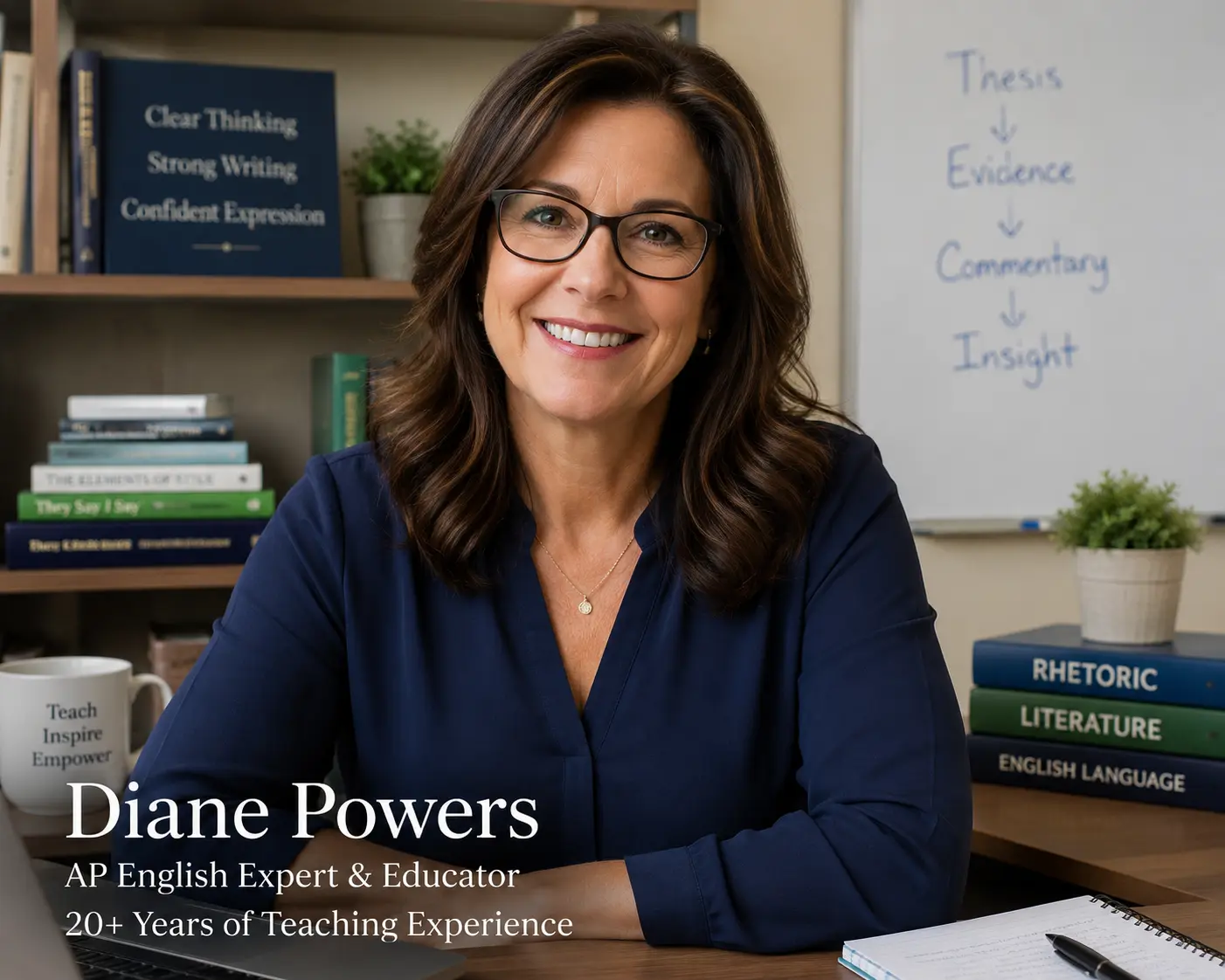
Representative educator illustration used for privacy purposes. Diane Powers serves as the educational reviewer for AP English Exam Prep and brings 29 years of classroom teaching experience and a University of Kansas education background to the site's review process.
Every page reviewed by Diane is evaluated for instructional clarity, accuracy, academic usefulness, and alignment with the reading, writing, and analytical skills students are expected to develop in advanced English coursework. Special attention is given to thesis development, evidence selection, commentary quality, literary interpretation, rhetorical analysis, complexity, and line of reasoning.
One of the biggest challenges students face in AP English is translating broad advice into practical action. Many resources tell students to “analyze more deeply” or “develop stronger commentary” without explaining what those phrases actually mean in a real essay. Diane's review process focuses on providing concrete explanations, examples, and decision-making frameworks that students can immediately apply to their reading and writing.
The goal of AP English Exam Prep is not simply to define literary and rhetorical terms. It is to help students become stronger readers, writers, and thinkers. Diane's extensive classroom experience helps ensure that the resources on this site remain practical, student-focused, and grounded in real educational experience.
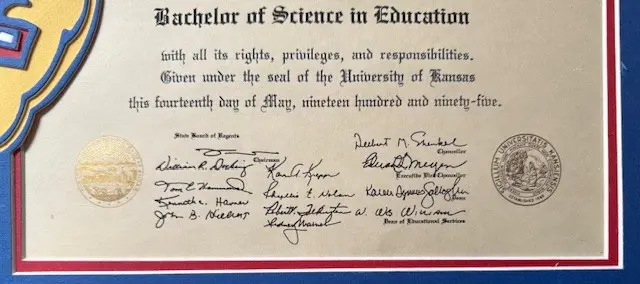
To ensure the highest level of subject-matter accuracy, content on AP English Exam Prep is audited and reviewed by curriculum collaborator Diane Powers. Diane reviews the material to provide specific "Teaching Tips," verify that essay frameworks align with current AP English rubrics, and ensure that complex concepts like line of reasoning and rhetorical analysis are broken down effectively for students. Every strategy guide undergoes this collaborative review process to guarantee it is practical and classroom-ready.Diane Powers earned a Bachelor of Science in Education from the University of Kansas School of Education. The diploma images below are provided to document educational background and support the site's commitment to transparency and educational credibility.
For personal privacy reasons, Diane Powers uses a representative educator portrait rather than a personal photograph. The educational background, teaching experience, and credentials referenced on this page are authentic and are documented through the supporting credential images shown below.

| Credential | Details |
|---|---|
| University Education | Bachelor of Science in Education, University of Kansas School of Education |
| Teaching Experience | 29 years of classroom teaching experience |
| Special Interests | English Literature, Composition, Critical Reading, Analytical Writing |
| Role on AP English Exam Prep | Educational reviewer and content quality reviewer |
Editorial Process
Every educational resource published on AP English Exam Prep is reviewed for accuracy, clarity, usefulness, and alignment with AP English reading and writing skills. Content is evaluated to ensure that examples are understandable, explanations are practical, and strategies can be applied by real students preparing for AP English Language and Composition or AP English Literature and Composition. I'm the main reviewer and if I feel I need to verify anything further, I discuss with other teachers in my department.
Pages are periodically updated as new resources are added, study methods evolve, and student needs change. Review dates are displayed throughout the site to promote transparency and accuracy.
What This Page Covers
Audience
The site is built primarily for high school students preparing for AP English exams, but the resources are also useful for teachers, tutors, parents, and counselors who want clearer AP English explanations.
Students can use the site to understand AP Lang and AP Lit exam expectations, build stronger essays, practice question logic, and study with a clearer plan.
Teachers and tutors can use the explanations as support for classroom review, writing workshops, student conferences, and exam-prep mini-lessons.
Parents and counselors can use the site to understand the difference between AP Lang and AP Lit and how students can prepare without wasting time on generic practice.
Coverage
AP English is not one subject with two interchangeable exam names. AP Lang and AP Lit reward different reading habits, writing decisions, and evidence strategies.
AP English Language and Composition, often called AP Lang, focuses on rhetoric, nonfiction, source use, synthesis, argument, and how writers shape claims for real audiences. This site treats AP Lang as a reasoning exam, not a vocabulary or device-naming test.
AP English Literature and Composition, often called AP Lit, focuses on imaginative literature, interpretation, close reading, poetry, prose fiction, literary argument, and how writers create meaning through structure and language.
Teaching Approach
The site is built around exam intelligence: the habits, traps, and scoring patterns that students need to understand before practice becomes useful.
| Common Generic Advice | What Students Actually Need | How This Site Approaches It |
|---|---|---|
| “Use evidence.” | Students need to know which evidence can support deep commentary. | Evidence is taught by function: support, qualify, complicate, contrast, illustrate, or reveal consequence. |
| “Analyze more.” | Students need to know the difference between summary and commentary. | Analysis is taught as a chain: observation, interpretation, function, significance, and connection. |
| “Know rhetorical devices.” | Students need to explain what rhetorical choices do for purpose and audience. | Rhetoric is taught by movement: credibility building, pressure, reframing, contrast, urgency, and qualification. |
| “Read closely.” | Students need to know what to look for while reading. | Close reading is taught through shifts, tension, repetition, structure, point of view, tone, and pattern. |
| “Practice more questions.” | Students need to review why answers are right or wrong. | Practice is taught through wrong-answer traps, question tasks, passage function, and reasoning errors. |
Website Ownership
AP English Exam Prep is independently operated and maintained by myself and other certified English teachers in my building for additional clarification as needed who are passionate about helping students prepare for advanced English coursework and exams. The site is not affiliated with the College Board nor endorsed by the College Board and exists solely as an independent educational resource.
Questions, corrections, feedback, or educational inquiries can be submitted through the site's contact page to reach out to me.
Editorial Standards
AP English Exam Prep is designed to be useful, transparent, and student-centered. Pages should help students make better decisions, not overwhelm them with recycled definitions.
The site avoids empty phrases such as “study hard,” “write better,” or “practice more” unless the page explains exactly what the student should do differently. A good AP English page should leave the student with a clearer mental model of the exam.
Information Gain Resources For This Site You Can Find Nowhere Else Online
Many AP English pages online repeat the same surface-level information: exam sections, essay names, and broad study tips. AP English Exam Prep is designed to build pages that add something more useful.
Generic AP English content often tells students what the exam contains but not how the exam behaves. It may define rhetorical analysis, synthesis, or literary argument without showing how scores are actually lost.
The site is designed to explain the hidden middle of AP English preparation: the reasoning decisions between reading a prompt and producing a score-worthy answer.
Trust Signals
A strong educational site should explain who it serves, what it covers, how it approaches the subject, and what standards guide its content.
The site exists to help students understand AP English exam expectations and practice with more precision.
The site covers AP Lang and AP Lit, with support for essays, multiple choice, scoring logic, evidence, and digital testing.
The site is independent and is not affiliated with the College Board, which owns the AP and Advanced Placement trademarks.
Independence
AP and Advanced Placement are registered trademarks of the College Board. AP English Exam Prep is not affiliated with, endorsed by, or sponsored by the College Board.
AP English Exam Prep uses AP exam names only to identify the exams students are preparing for. The site is an independent study resource designed to help students understand exam expectations, writing strategy, and practice methods.
Because AP course and exam details can change over time, students should also consult official school materials, teacher guidance, and current College Board information when making exam decisions or confirming test-day requirements.
Explore The Site
These are the main pages and future sitewide pillars for students using AP English Exam Prep.
FAQ
No. AP English Exam Prep is an independent educational website. AP and Advanced Placement are registered trademarks of the College Board, which is not affiliated with this site.
The site covers AP English Language and Composition and AP English Literature and Composition, including exam structure, essays, multiple choice, scoring logic, practice strategy, and digital exam preparation.
The site is mainly for high school students preparing for AP English exams, but it can also help teachers, tutors, parents, and counselors who want clearer explanations of AP Lang and AP Lit.
The site focuses on exam behavior, reader expectations, line of reasoning, commentary, wrong-answer traps, evidence quality, and digital test strategy instead of generic advice or repeated definitions.
No. The site is best used as a study support resource alongside teacher instruction, official school materials, classroom assignments, and current exam information.